9.1 概述
介词(Preposition)是一种结构词,不能单独担任句子成分。介词的作用是表示它后面的宾语同句中其他词语之间的关系。介词连同其宾语构成介词短语,介词短语可以担任多种句子成分。
介词通常具有多种词义,能与不同的词语搭配,表示不同的意义。
根据形式,介词分为简单介词(Simple Preposition)和复合介词(Complex Preposition)。简单介词由一个单词构成,复合介词由两个或两个以上单词构成。
有些介词与副词、连词等同形。既可作介词又可作副词的词(如:up,down)被称为副词小品词(Adverb Particle)或介词副词(Prepositional Adverb)。
(1)主要的简单介词
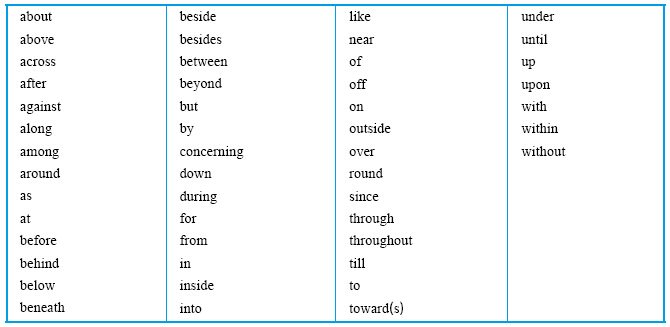
注:据语法学家的统计,最常用的介词是:at,by,for,from,in,of,on,to,with九个。
(2)复合介词
复合介词有:according to,apart from,as for,as to,away from,because of,but for,due to,except for,further to,instead of,next to,on to,out of,owing to,regardless of,up to,as well as,by means of,in addition to,in case of,in the face of,in favour of,in front of,in spite of,in view of,on account of,on behalf of,on top of,with reference to,with regard to等。复合介词是由两个或更多的词组成,其作用相当于一个简单介词。但是简单介词与复合介词的界限并不是十分清楚的,例如into是一个词,因而被看做简单介词,而onto通常被分写为on to,因而被视为复合介词,如:
He walked into the room.
他走进房间。
He jumped on to the stairs.
他跳到楼梯上。
但是分写的in to则是“副词+介词”,on to也可能是这样,如:
We went in to drinking.
我们走进去吃饭。
You’d better walk on to the next newsstand to find it.
你最好继续走到下一个报亭去找找看。
有些复合介词的形式是不可改变的,如:in acknowledgement of,而有些复合介词,如:in front of,on behalf of,却有一些并不是介词的变体形式,如:in front,on John’s behalf。
复合介词中的名词表示笼统意义,不带冠词,如:in front of,in view of。在“介词+名词+介词+名词”的词组中,如果第一个名词前有冠词,如:in the front of the car,我们并不把它看做是“复合介词+名词”的结构,而看做“介词+名词短语”的结构,即:in+the front of the car。
有些复合介词去掉后面的介词之后便成为其他词类,如,副词as a result,at the point,连词because,in case。
关于due to的词性,有一些不同看法。在下面的句子中,due很显然是形容词。
The rent is due tomorrow.
明天房租就到期了。
有些语法学家不同意把due to看做介词,认为“due to+名词”是一个“形容词+介词短语”的结构,不能作状语,只能作主语补语,如:
His illness was due to bad mood.
他的病是由于情绪不好引起的。
但是,“due to+名词”作状语毕竟是一种常见的用法,如:
He became ill due to bad mood.
他生病是由于情绪不好引起的。
(3)介词短语
介词短语(Prepositional Phrase)由介词及其宾语构成。介词宾语可由下列词、短语及从句构成:
①名词,如:out of action,on earth
②代词,如:beyond one’s means,at one’s wit’s end
③数词,如:at ten,in 1854
④形容词,如:at least,for all
⑤副词,如:from abroad,until recently
⑥介词短语,如:under the cover of,out of touch with
⑦不定式(短语),如:
This is a problem of which to solve.
是解决哪个问题的问题。
⑧动名词(短语),如:by studying hard,before coming here
⑨名词性从句,如:
Americans today don’t place a very high value on what they don’t have.
今天的美国人并不是很在意他们没有什么。
They all congratulated him on what he has got.
大家都祝贺他所得到的一切。




本书评论