8.3 被动语态
8.3.1 概述
语态(Voice)是一种动词形式,表示主语与动词所表示的动作之间的关系。英语动词有两种语态:主动语态(Active Voice)和被动语态(Passive Voice)。
主动语态表示主语是动作的执行者(Agent),又称施动者;被动语态表示主语是动作的承受者(Recipient),又称受动者。谓语动词为主动语态的句子叫主动句,谓语动词为被动语态的句子叫被动句。
当主动句转换为被动句时,原来的宾语变成了主语,原来的主语变成了介词by的宾语,同时,动词由主动语态变成被动语态,如:
主动句:Improved nutrition has increased physical vitality.
营养的改善增强了身体的活力。
被动句:Physical vitality has been increased by improved nutrition.
由于营养的改善,身体的活力已经增强。
主动句与被动句的结构虽不同,但动作执行者和承受者的关系并没有改变。
动词的被动语态由“助动词be+及物动词的过去分词”构成。
8.3.2 被动语态的形式
英语被动语态是由“助动词be+及物动词的过去分词”构成的。助动词be有时与体的变化,被动语态的时与体就是借助动词be来体现的。助动词be还要在人称和数上与主语保持一致。
现以动词do为例,列表介绍被动语态的各种时、体形式:

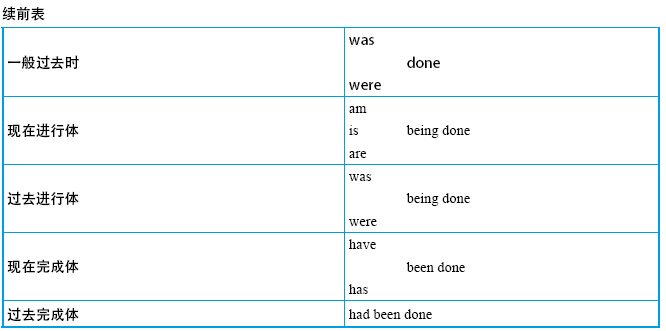
(1)在表示将来时间时,被动语态可用“shall/will+be+过去分词”或“be going to+be+过去分词”等形式表示。
被动语态的现在完成进行体和过去完成进行体是两种罕用的形式,如:
The reflected heat of the sun has been being used to cook for many years.
多年以来人们一直在利用反射太阳光的热量来做饭。
(2)与主动语态一样,被动语态的前面也可以带情态动词,如:
Many books may have been being written about the future.
很多书也许写了有关未来的事。
(3)含有复合宾语的主动句的转换
在把含有复合宾语的主动句变为被动句时,把其中的宾语变成被动句的主语,原来的宾语补语变成主语补语。作主语补语的可以是名词(短语)、形容词(短语)和非限定动词(短语),其中,不定式一律带to,如:
The discovery of the laser has made new systems of television possible.
→New systems of television have been made possible by the discovery of the laser.
新的电视系统已经因为激光的发现而得以实现。
At the moment I am making my car ready for a long journey.
→At the moment my car is being ready for a long journey.
此时,我的车正在为长途旅行做准备。
带复合宾语的动词有:appoint,call,declare,elect,get,keep,leave,like,make,name,see,vote,want等。
(4)含有介词动词的主动句的转换
介词动词(Prepositional Verb)的作用相当于及物动词,因此通常可用于被动句,如:
Someone has adapted some young adult novels for young readers.
→Some young adult novels have been adapted for young readers.
有些成人小说经过改编后给年轻人阅读。
She wants to know whether they have agreed upon the measures.
→She wants to know whether the measures have been agreed upon.
她想知道这些措施是否已经得到一致同意。
有些介词动词的被动语态只能表示引申意义,如:
The case should be looked into again.
这个案子必须重新调查。
Finally the contract was arrived at.
最后终于签了合同。
像He looked into the window.或We arrived at the airport.这样的主动句就不能变成被动句。
(5)含有短语动词的主动句的转换
带宾语的短语动词(Phrasal Verb)的作用相当于及物动词,因此通常可用于被动句,如:
The driver’s carelessness brought about the accident.
→The accident was brought about by the driver’s carelessness.
这次车祸是司机的疏忽大意导致的。
The machines will take over the repetitive tasks of industry.
→The repetitive tasks of industry will be taken over by the machines.
工业中重复性的工作将被机器取代。
不带宾语的短语动词不能用于被动句。
(6)含有短语介词动词的主动句的转换
短语介词动词(Phrasal-Prepositional Verb)的作用相当于及物动词,因此通常可用于被动句,如:
The police is looking for the thief.
→The thief is being looked for by the police.
警察正在寻找那个小偷。
A loud noise during the night woke us up.
→We were woken up by a loud noise during the night.
夜里一声巨响吵醒了我们。
(7)含有固定动词短语的主动句的转换
有些“动词+名词+介词”构成的短语已经固定化了,其作用相当于及物动词,如:pay attention to(=heed),take care of(=tend),make fun of(=ridicule),find fault with(=criticize),lose sight of(overlook),set fire to(=ignite),take advantage of(=utilize),put a stop to(=stop)等。把含有这种短语的主动句变成被动句的方法有两种:
①把主动句的宾语变成被动句的主语;
②把该短语中的名词变成被动句的主语,如:
You shouldn’t make fun of the disabled.
→The disabled shouldn’t be made fun of.
→Fun shouldn’t be made to the disabled.
你不应该取笑残疾人。
Everyone have to take advantage of the existing resources.
→The existing resources have to be taken advantage of by everyone.
→Advantage have to be taken of the existing resources by everyone.
人们应该利用现成资源。




本书评论