六、乌克兰独立全民公决
有2个重要的问题悬而未决。乌克兰的独立宣言真的获得大部分乌克兰人的支持吗?换句话说,它是否是合法的、建立在公意之上的?另外,在苏联迅速解体的混乱中,乌克兰在什么样的基础上发展同其他后苏联时代国家关系呢?换句话说,苏联的分家事宜如何处理呢?
第一个问题在1991年12月1日得到解决。乌克兰人参加了关于独立和选举第一届总统的投票。自8月的独立宣言以来,苏联和俄罗斯当局并没有进行干涉,乌克兰已经按照独立国家的姿态行事,所有主要政党和大众媒体建立起了一个支持独立的平台。乌克兰独立在全国各个州都获得支持(详见表2)。不仅西乌克兰以压倒优势支持这项决议,东部和南部,甚至以俄罗斯裔为主的克里米亚地区也赞成乌克兰独立,尽管数据比起其他地区较低。但这个结果并不意味着所有乌克兰人都是积极的民族主义者。据调查显示,投票者关注的主要是经济问题,乌克兰文化复兴或维护乌克兰政治主权的考虑则排在次席。调查同样反映了乌克兰种族文化的分裂,俄罗斯裔和其他少数族裔以及俄罗斯东正教会的成员明显比乌克兰裔或希腊天主教会及乌克兰独立东正教会的成员对独立的支持率低很多。㊵ 尽管如此,绝大部分乌克兰人还是拥抱了独立,这在6个月前还被称为“极端”的观念,也表明1991年下半年乌克兰的变化究竟有多么大。
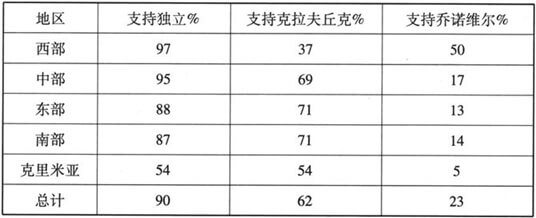
有6名候选人竞选乌克兰总统,2个主要的竞争对手克拉夫丘克和乔诺维尔此时已经成为鲁赫最为显赫的政治人物。克拉夫丘克把自己描述为经验丰富的稳健派。在承诺乌克兰独立的同时,他共产党高级官员的背景也足以安抚那些不希望乌克兰未来发展走向极端方向的人。因为媒体掌握在民族共产主义者手中,所以克拉夫丘克在新闻报道中与他的竞争者相比占有很大优势。克拉夫丘克作为左翼竞选人,同样得到了社会党和其他主要集中在东乌克兰的较小的左翼政党的支持。而乔诺维尔的支持面相对较窄,许多人把他看作是激进的或不可预测的选择。乔诺维尔在西乌克兰,尤其在加利西亚的成绩不错,但如表2所示,克拉夫丘克在除西乌克兰以外的所有地区都轻松赢得胜利。
尽管乌克兰的新领导人需要在独立之前做出许多重要决策,例如怎样处理乌克兰领土上的核武库,如何进行经济改革,新国家象征物是什么,但有一个问题亟待解决,那就是确保苏联的解体以和平方式进行。乌克兰在8月的独立宣言实际上已经宣告了苏联的终结,12月1日以后联盟的重建已再无可能。不仅乌克兰想脱离苏联,而且更为重要的是俄罗斯也如此打算。在8月至12月间,已经于7月当选为俄罗斯总统的叶利钦冷淡地回绝了戈尔巴乔夫关于重组加盟共和国之间关系的呼吁。甚至较少有民族主义动员的中亚国家也有意脱离联盟。1991年12月8日,在一场狂欢酒宴后,叶利钦、克拉夫丘克和白俄罗斯领导人斯坦尼斯拉夫·舒什克维奇(Stanislav Shushkevich)在昔日勃列日涅夫位于西白俄罗斯的乡间别墅会面,一致同意肢解苏联。他们引证历史——既然1922年这3个国家是苏联的创始国,那么就有权利分裂苏联,取而代之的将是随后成立的独立国家联合体(CIS)。这一组织旨在保证苏联各加盟国家的平稳分离,并维持彼此间的政治、经济、安全和文化纽带。其他后苏联国家(但不包括波罗的海三国)也陆续加入独联体。独联体的具体功能和权力并没有得到明确界定,但清楚的是——克拉夫丘克也强调了这一点——它并非是改造后的新联盟。相反,独联体是一个纯粹的主权国家自愿加入的组织。克拉夫丘克返回基辅后,曾担心旧的权力核心力量——军队或克格勃——的干涉,但这些组织已经被叶利钦所控制。苏联在1991年12月25日宣布终止,乌克兰获得了独立。
注释
① The most commonly cited exception is Helene Carriere d'Encausse, Decline of an Empire (New York: Newsweek Books, 1980), who mistakenly argued that the main problem would be Muslim uprisings in Central Asia. Even as late as 1990, many leading scholars thought the breakup of the Soviet Union was unlikely. See various contributions in Alexander Motyl, ed. Thinking Theoretically about Soviet Nationalities (New York: Columbia University Press, 1992)
② The best treatment of Gorbachev is Archie Brown, The Gorbachev Factor (OxfordL Oxford University Press, 1997).
③ Mark Beissinger, Nationalist Mobilization and the Collapse of the Soviet State (Cambridge: Cambridge University Press, 2002).
④ Bohdan Nahaylo, The Ukrainian Resurgence (London: Hurst and Company, 1999), pp. 57—58.
⑤ Anna Reid, Borderland: A Journey through the History of Ukraine (Boulder: Westview, 1997), p. 201.
⑥ Reid, 1997, pp. 194—195.
⑦ Serhy Yekelchyk, Ukraine: Birth of a Modern Nation (Oxford: Oxford University Press, 2007), p. 179.
⑧ Reid, 1997, pp. 194, 204.
⑨ "Waiting for the Next Chernobyl," Financial Times, April 21, 1993.
⑩ Nahaylo, 1999, p. 60.
⑪ Roman Solchanyk, Ukraine: From Chernobyl to Sovereignty (New York: St. Martin's, 1992), p. xiii.
⑫ Reid, 1997, p. 205.
⑬ Literaturna Ukraina, July 9. 1987.
⑭ Nahaylo, 1999, pp. 62—63.
⑮ Quoted in Taras Kuzio and Andrew Wilson, Ukraine: Perestroika to Independence (New York: St. Martin's, 1994), pp. 66.
⑯ Quoted in Kuzio and Wilson, 1994, p. 71.
⑰ Kuzio and Wilson, 1994, p. 74.
⑱ Nahaylo, 1999, pp. 172—173.
⑲ Nahaylo, 1999, pp. 192—193.
⑳ Kuzio and Wilson, 1994, p. 111.
㉑ Nahaylo, 1999, p. 218.
㉒ Kuzio and Wilson, 1994, p. 111 and Nahayli, 1999, p. 218.
㉓ Ilya Prizel, "Ukraine Between Proto-Democracy and 'Soft' Authoritarianism," in Karen Dawisha and Bruce Parrott, eds. Democratic Changes and Authoritarian Reactions in Russia, Ukraine, Belarus, and Moldova (Cambridge: Cambridge University Press, 1997), pp. 338—339.
㉔ Andrew Wilson, Ukrainian Nationalism in the 1990s: A Minority Faith (Cambridge University Press, 1996).
㉕ Alexander Motyl and Bohdan Krawchenko, "Ukraine: from Empire to Staehood", in Ian Bremmer and Ray Taras, eds. New State, New Politics: Building the Post-Soviet Nations(Cambridge: Cambridge University Press, 1997), p. 246.
㉖ A good source for worker mobilization in Ukraine is Sue Dvis, Trade Unions in Russia and Ukraine, 1985—1995 (New York: Palgrave, 2001).
㉗ Members of the Donbass Regional Strike Committee were present at Rukh's founding congress, but the relationship between the miners and the intellectuals and political prisoners involved with Rukh was always tenuous. For example, the miners' movement agreed with Rukh about republican sovereignty, but it expressed reservations about the use of Ukrainian national symbols, which subsequently were not adopted as the official symbols of Rukh.
㉘ Motyl and Krawchenko, 1997, p. 244.
㉙ Literaturna Ukraina, April 5, 1990.
㉚ Motyl and Krawchenko, 1997, p. 247.
㉛ Motyl and Krawchenko, 1997, p. 248.
㉜ Andrew Wilson, The Ukrainians: Unexpected Nation (New Haven, CT: Yale University Press, 2000), p. 160.
㉝ Kuzio and Wilson, 1994, p. 127.
㉞ Yekelchyk, 2007, p. 184.
㉟ Wilson, 2000, pp. 163—165.
㊱ Yekelchyk, 2007, p. 186.
㊲ Nahaylo, 1999, p. 352, and Wilson, 2000, p. 165.
㊳ Wilson, 2000, pp. 166—167.
㊴ Wilson, 2000, p. 168.
㊵ Kuzio and Wilson, 1994, p. 190.




本书评论